Islam Is a Way of Life
The word “Islam” means “surrender or submit,” and a “Muslim” is one who submits his/ her will to God (Allah, in Arabic). Because God is Lord of the universe, every aspect of the believer’s life is to be submitted to God, including economic, political, social and spiritual life.
Some Basic Tenets
God
The basic tenets of Islamic belief begin with the Unity of God. A Muslim confesses simply, “There is no god but God, and Muhammad is his Prophet.” This doctrine would prohibit Muslims from associating anything with God that is not God, such as idols or human beings.
Prophesy and Revelation
Muslims see God acting in history by the granting of revelations through the prophets. God’s prophets include Adam, Noah, Abraham, Moses, David, Jesus and Muhammad, to whom God has given God’s message as a reminder to human beings of God’s will for their lives. Moses was given the Torah; Jesus, the Gospel; Muhammad, the Quran.
Muslims profess belief in all of God’s revelations to humanity through the prophets and the books. The prophets are not to be elevated above normal human beings, though they are considered to be models of true faith and practice. As the culmination of all prophetic revelations, the Quran (the “recitation”) is God’s word, given in the Arabic language. It nurtures spiritual life, directs social and personal life, and provides the richness of Muslim liturgical expression.
The Last Day
Muslims teach that there will be a Last Day on which God will judge each human being according to her/his good and evil deeds. On that day, human beings will be rewarded with paradise or punished with hell, according to God’s mercy and justice.
Angels
In addition, Muslims share a belief in angels as messengers of God to humanity and as agents of God’s activity on earth. The angel Gabriel, for instance, recited the words of the Quran to Muhammad. God created angels to interact with human lives, bringing his divine message. Each Muslim has two guardian angels who record that person’s good and bad actions.
The Five Pillars of Practice
The practice of Islamic faith has been described as the “five pillars:” profession of faith, prayer, giving one’s material substance, fasting and pilgrimage. The profession of faith expresses belief in the “unity of God” and in God’s messengers, the final one being Muhammad. Muslims are enjoined in the Quran to pray five times daily at specified times, whether at home, in the office or in the mosque. The requirement to give a proportion of income/wealth is a means by which the community cares for its less fortunate members. Each year during the month of Ramadan, Muslims observe a strict fast, for purification and repentance, from sunrise to sunset each day. And finally, the pilgrimage is enjoined on those Muslims who have means to go and perform prescribed rituals at the Ka’bah in Mecca, in modern Saudi Arabia. Muslims from around the globe dress in simple garments to worship together in this holy city.
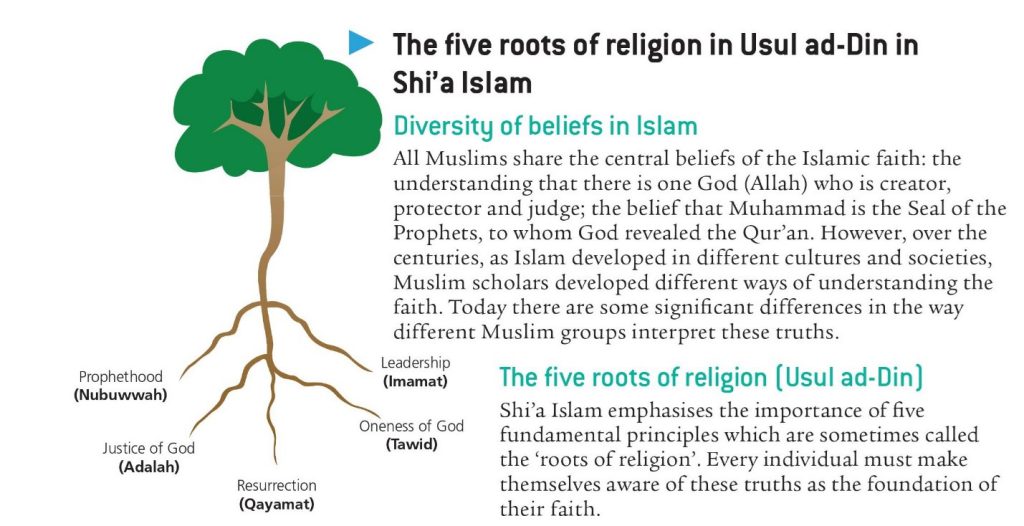
Usul ad-Din, the five roots of religion, can also be referred to as the ‘foundation of faith’. They are:
▶ Oneness of God (Tawid)
▶ Justice of God (Adl or Adalah)
▶ Prophethood (Nubuwwah)
▶ Leadership (Imamat)
▶ Resurrection (Qayamat).
1 The oneness of God (Tawid): There is one God who has no equals; he is a divine unity. He cannot be compared to anyone or anything. He is perfect and unique and he possesses
infinite power and knowledge. He is immortal (he was never born) and has no partner or children. He alone should be worshipped.
‘Say, “He is God, [who is] One, God, the Eternal Refuge.’ Qur’an 112:1–2
2 The justice of God (Adl or Adalah): God is perfect justice, fairness and wisdom. He does not wrong anyone and he will not tolerate wrongdoing. He cannot abuse his power by performing acts that go against his own nature to be just and fair. Humans must be responsible for their own actions, good or bad.
3 Prophethood (Nubuwwah): God has appointed prophets and messengers to guide human beings, showing them how to live in peace and submission to God. According to some Islamic sources, God sent 124,000 prophets; some of these bought divine scriptures with them, from God. Muhammad was the Seal of the Prophets, meaning that he brought the fi nal, perfect and unchanging message from God.
4 Leadership (Imamae): All Muslims believe that Muhammad was the last prophet, who brought the fi nal scripture (the Qur’an) to humanity. Shi’as believe that, after his death, God appointed 12 infallible Imams to guide the Muslim community, leading them on the path set by the Prophet Muhammad. These Imams are part of what Shi’as call Ahl al-Bayt (the Family of the House). In other words, they are part of Prophet Muhammad’s extended household.
Of these 12, 11 have been killed. They believe that the 12th (or hidden) Imam is still alive, but is in hiding (occultation), waiting to reappear and rule on earth with justice. They sometimes refer to him as the Mahdi.
5 Resurrection (Qayamat): The belief that, on the Day of Judgement, there will be a resurrection, when all human beings will be physically raised to life to be judged by God. He will reward the good and punish the evil.
‘So whoever does an atom’s weight of good will see it, and whoever does an atom’s weight of evil will see it.’ Qur’an 99:7–8